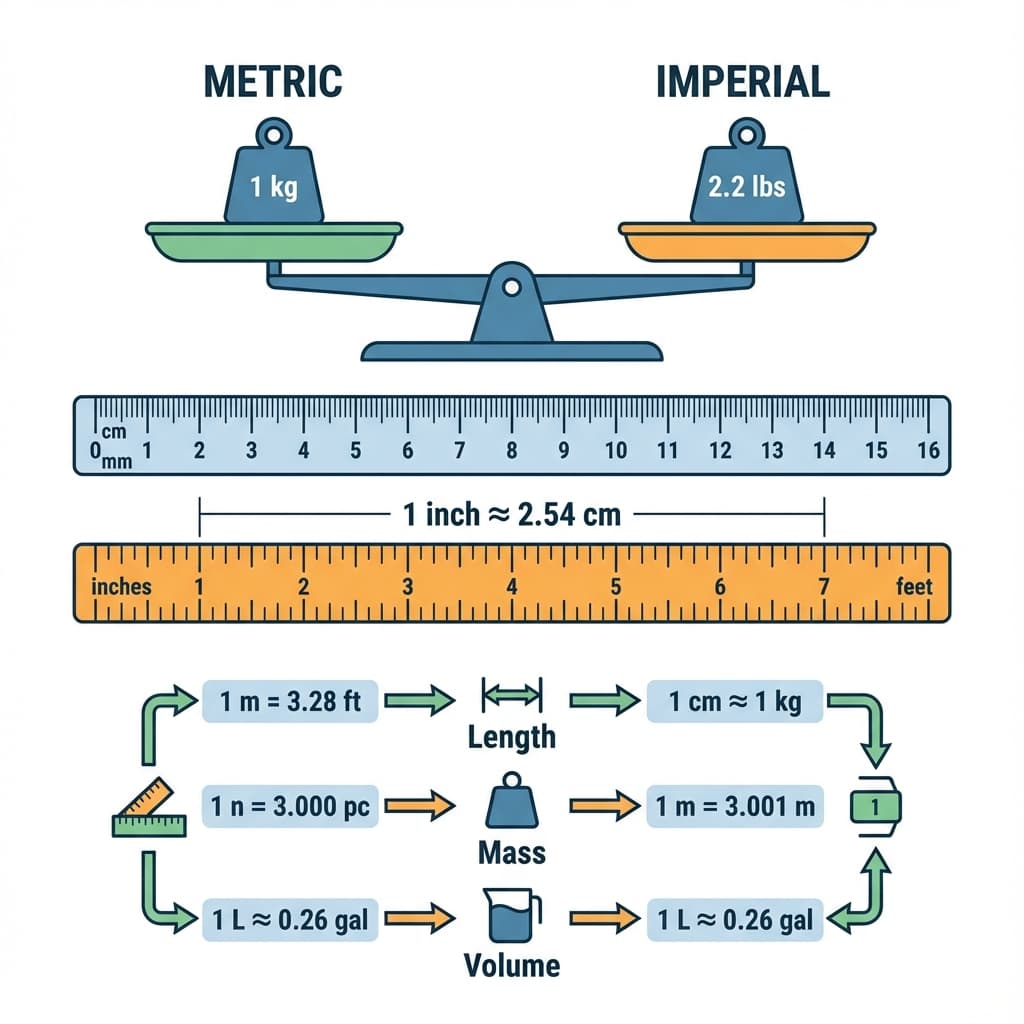
In the world of 3D geometry and engineering, calculating volume is only half the battle. The real challenge often lies in converting those calculations into useful units. Whether you're an engineer working with cubic meters or a home brewer measuring in gallons, mastering unit conversion is essential.
Why Unit Conversion Matters
Volume units vary significantly across industries and regions. The US Customary system uses gallons and cubic feet, while the Metric system relies on liters and cubic meters. Mixing these up can lead to disastrous results—from failed chemistry experiments to major construction errors.
Key Principle
Always maintain consistency. Convert all dimensions to a single unit system (e.g., all meters or all feet) before calculating volume, then convert the final result to your desired output unit.
Common Volume Conversion Factors
Here are the most frequently used conversion factors you should keep handy:
| From Unit | To Unit | Multiply By |
|---|---|---|
| Cubic Meters (m³) | Liters (L) | 1,000 |
| Liters (L) | Gallons (US) | 0.264172 |
| Cubic Feet (ft³) | Gallons (US) | 7.48052 |
| Gallons (US) | Milliliters (mL) | 3,785.41 |
| Cubic Yards (yd³) | Cubic Feet (ft³) | 27 |
Liquid vs. Solid Volume
It's important to distinguish between measurements typically used for solids (cubic meters, cubic feet) and those used for liquids (liters, gallons).
- Solids: Usually measured in m³, cm³, ft³, in³. Examples: Concrete, timber, soil.
- Liquids: Usually measured in L, mL, gal, fl oz. Examples: Water, fuel, beverages.
However, they are directly interchangeable. Ideally, memorizing that 1 cubic meter = 1000 liters acts as a perfect bridge between the two systems.
Pitfalls to Avoid
US vs. UK Gallons
A US gallon (3.785 L) is smaller than a UK/Imperial gallon (4.546 L). Always check which "gallon" is required.
Linear vs. Cubic Conversion
1 meter = 100 cm, but 1 cubic meter ≠ 100 cubic cm. It is 1,000,000 cm³ (since 100 × 100 × 100).